
Lifestyle
Zojirushi SW-KA52 Food Jar Review: Lunch That Is Actually Still Hot at Noon
A research-based review of Zojirushi's newest stainless food jar: the Therma Chamber lid, the brand's best published heat retention, a three-part cleanup, and who should buy it.
Research note: This guide compares published specifications and current retail information. It is not presented as a hands-on test.
Disclosure: As an Amazon Associate I earn from qualifying purchases. Product links marked “paid link” may earn AmeChoi a commission.
Contents
- SW-KA52 at a glance
- What the new generation actually improves
- The Therma Chamber lid closes the category’s weak point
- Three parts is a daily-use spec, not a footnote
- The mouth is built for eating, not just filling
- How to actually get 6 hours of heat
- The limitations to accept
- Who should buy it?
- Frequently asked questions
- Is food still safe after six hours?
- Can I put rice or pasta in it?
- How is this different from a Thermos-brand food jar?
- Does it leak in a backpack?
- Pair it with a drink bottle?
- Final verdict
- Sources and methodology
The packed-lunch problem is temperature. A sandwich shrugs it off, but the lunches worth looking forward to — soup, stew, curry, chili, oatmeal, leftovers from a good dinner — are a different meal at 140°F than at 100°F. Microwave access solves it at the office; a job site, a classroom, a hike, or a long drive does not come with a microwave.
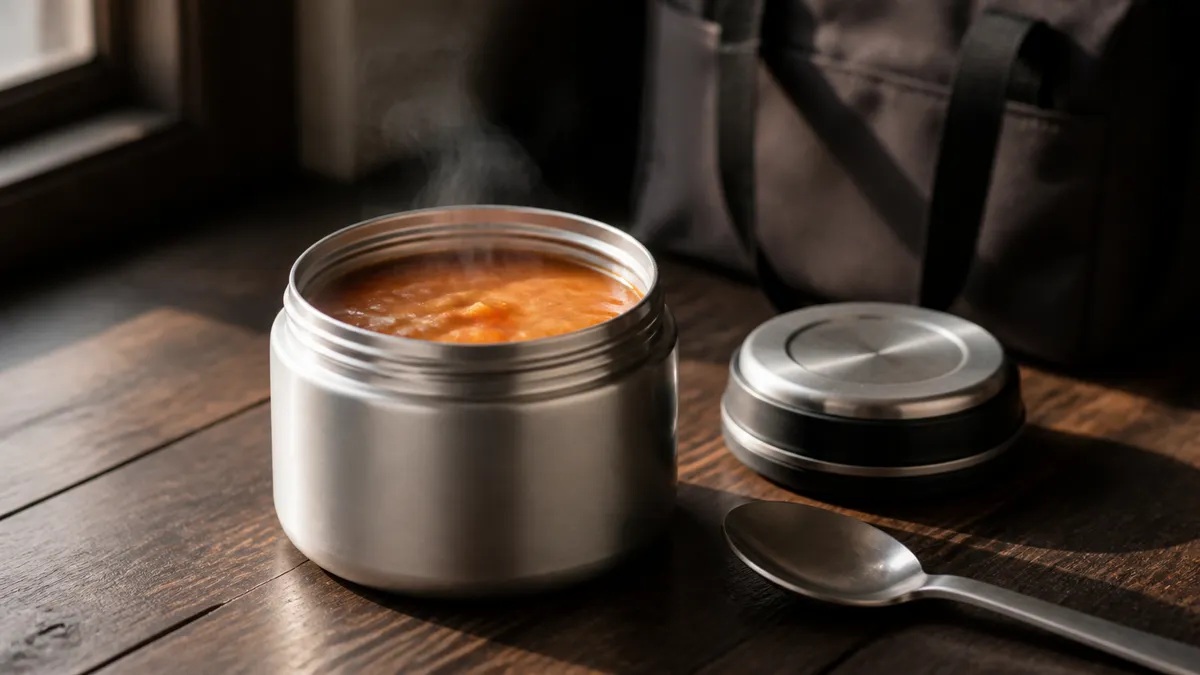
This is the problem vacuum-insulated food jars exist for, and it is a category Japanese makers have quietly dominated for decades — the same physics as a good travel mug, in a wide-mouth jar you can eat from. The Zojirushi SW-KA52H is the newest generation of the company’s food jar line, and its pitch is specific: the brand’s best published heat retention yet, in a jar that washes up as just three parts.
The verdict up front: this is the food jar to buy if hot lunch away from a microwave is the goal. The honest caveats are the usual ones for the category — it holds one meal, it needs preheating to hit its numbers, and it is a jar, not a cooler bag, so it does one temperature at a time.
Best hot-lunch food jar
Zojirushi Stainless Steel Food Jar SW-KA52H
SW-KA52H · 18 oz (0.52 L)
Zojirushi's newest food jar generation: the Therma Chamber lid pushes retention to the brand's best published numbers, while the seamless one-piece stopper cuts cleanup to three parts.
- Best for
- Packed lunches that should still be genuinely hot at noon
- Heat retention
- 153°F at 6 hrs — Zojirushi's highest for a food jar
- Lid
- Seamless Therma Chamber stopper, integrated gasket
- Cleanup
- Only 3 parts to wash
- Interior
- 18/8 stainless, wide bowl-style mouth
SW-KA52 at a glance
| Specification | Zojirushi SW-KA52H |
|---|---|
| Capacity | 18 oz (0.52 L) — a generous single serving |
| Heat retention | 153°F after 6 hours (Zojirushi’s highest published for a food jar) |
| Lid | Seamless Therma Chamber stopper with integrated gasket |
| Parts to wash | 3 |
| Interior | 18/8 stainless steel, wide bowl-style mouth |
| Larger sibling | SW-KA75H (25 oz) |
Two numbers in that table are the story. 153°F at hour six means soup filled at breakfast is still genuinely hot — not lukewarm — at a late lunch. And three parts is the quiet quality-of-life spec: earlier food jars (Zojirushi’s own included) used stoppers that disassembled into more pieces with a separate gasket to unseat, scrub, and reseat every day.
What the new generation actually improves
The Therma Chamber lid closes the category’s weak point
Every vacuum food jar has the same thermal hole: the lid. The body is a vacuum bottle, but the stopper is where heat escapes. Zojirushi’s Therma Chamber design builds insulating chambers into the stopper itself, and the result is the retention figure above — the company’s best food-jar number to date, a few degrees over its long-running previous models (the older SW-EAE50, for comparison, publishes 147°F at six hours).
A few degrees sounds minor. Across the category it is the difference between “pleasantly hot” and “warm enough,” and it compounds with how well you preheat.
Three parts is a daily-use spec, not a footnote
The stopper is a seamless one-piece design with its gasket integrated rather than removable. Day to day that means: jar, stopper, outer lid — wash, dry, done. No prying a gasket out of a groove, no gasket lost down the drain, no funk developing in a seam you forgot existed. For an object used five days a week, cleanup friction decides whether it stays in rotation, and this is the most cleanable design Zojirushi has shipped in the line.
The mouth is built for eating, not just filling
The jar’s wide, bowl-like opening takes a spoon at real angles, and the interior is electro-polished 18/8 stainless that resists staining and odor from tomato-based and curry lunches. An 18-ounce capacity fits a full adult portion of soup or stew with room for a practical fill line.
How to actually get 6 hours of heat
Published retention assumes you help the jar, and Zojirushi’s own guidance is the checklist worth repeating:
- Preheat. Fill the jar with boiling water, lid on, for a few minutes while the food heats. Dump the water, fill with piping-hot food. Skipping this step is the number one reason food jars “underperform.”
- Fill it properly. A nearly full jar holds temperature far better than a third-full one — less air, more thermal mass.
- Fill hot, eat within the window. The jar keeps temperature; it does not cook or reheat. Zojirushi’s guidance is to consume the contents within about six hours — this is a food-safety window, not just a temperature one.
The same physics works cold: pre-chill with ice water for overnight oats, noodle salads, or fruit in summer.
The limitations to accept
It is one hot meal, not a lunch system. Rice-plus-sides or multi-course lunches are the territory of Zojirushi’s multi-container lunch jars; the SW-KA52 is a single excellent vessel.
It does not go in the microwave. Stainless vacuum construction means what goes in hot stays hot — and what goes in lukewarm stays disappointing. The preheating ritual is not optional if you want the published numbers.
Carbonated drinks and long-held dairy are off the menu, per the manufacturer’s standard guidance for sealed vacuum vessels — pressure and spoilage respectively. Soup, stew, curry, chili, pasta, oatmeal, and rice dishes are the intended range.
Hand wash. As with Zojirushi’s mugs, the maker recommends hand washing over the dishwasher. Three parts makes this a two-minute job, but it is a job.
Who should buy it?
The SW-KA52 is a good fit if:
- Your lunch happens somewhere without a microwave — job site, vehicle, classroom, trail, or a desk you would rather not leave.
- Soup, stew, curry, or leftovers are your idea of a real lunch.
- You have abandoned a previous food jar because cleaning its lid was annoying.
- You want the current best-performing version of a proven product line.
Skip it if:
- Your lunches are cold or room-temperature anyway — a simple bento box does that for less.
- You need to pack multiple courses — look at multi-tier lunch jars instead.
- An 18-ounce single serving is too small for your appetite; consider the 25 oz SW-KA75H sibling.
Frequently asked questions
Is food still safe after six hours?
Zojirushi’s guidance is to fill hot (or cold), keep the jar sealed, and eat within about six hours. The jar’s role is keeping food out of the lukewarm danger zone during that window — which is exactly what the high retention numbers do. It is not a device for storing food all day and eating at dinner.
Can I put rice or pasta in it?
Yes — hot rice, pasta dishes, and oatmeal are standard uses. Fill hot and reasonably full for the best result. Dry-ish foods hold heat less well than brothy ones, so soups and stews are where the jar shines most.
How is this different from a Thermos-brand food jar?
The mechanics are similar; the differences are in the published numbers, the lid engineering, and the cleanup design. Zojirushi publishes specific retention figures and has made the seamless three-part stopper its differentiator in this generation. If you are comparing, compare the “at 6 hours” numbers and the number of lid parts — those two specs predict daily satisfaction better than capacity or color.
Does it leak in a backpack?
The stopper is a sealed, gasketed design intended for upright transport in a bag. As with any food jar, the practical failure mode is a worn or misseated gasket — one more argument for the integrated-gasket design, which cannot be reassembled wrong.
Pair it with a drink bottle?
That is the classic Japanese lunch loadout: a food jar for the meal, a slim mug bottle for the drink. Our Zojirushi travel mug comparison covers the drink half of that pairing.
Final verdict
The SW-KA52 is the best version yet of a product Zojirushi already did better than almost anyone. The Therma Chamber lid buys real degrees at hour six, the three-part cleanup removes the reason food jars get abandoned, and the wide stainless bowl is simply pleasant to eat from.
If a hot lunch without a microwave would upgrade your workday, this is one of the highest-satisfaction-per-dollar objects in the Japanese kitchenware canon. Preheat it, fill it full, and lunch stops being a compromise.
Preheat it and it delivers
Zojirushi Stainless Steel Food Jar SW-KA52H
SW-KA52H · 18 oz (0.52 L)
Zojirushi's newest food jar generation: the Therma Chamber lid pushes retention to the brand's best published numbers, while the seamless one-piece stopper cuts cleanup to three parts.
- Best for
- Packed lunches that should still be genuinely hot at noon
- Heat retention
- 153°F at 6 hrs — Zojirushi's highest for a food jar
- Lid
- Seamless Therma Chamber stopper, integrated gasket
- Cleanup
- Only 3 parts to wash
- Interior
- 18/8 stainless, wide bowl-style mouth
Sources and methodology
This is a research-based buying guide, not a hands-on test. Specifications and retention figures were checked against the manufacturer’s published US product pages on August 15, 2026. Retail availability, colors, and pricing change independently of these specifications.