
Desk Setup
BackJoy SitSmart Core 2.0 Review (2026): Shape Beats Padding
A research-based review of the BackJoy SitSmart Core 2.0 posture seat: what a shaped pelvic orthotic does that a flat cushion cannot, and how to pick between the Core, Relief, and MINI size bands.
Research note: This guide compares published specifications and current retail information. It is not presented as a hands-on test.
Disclosure: As an Amazon Associate I earn from qualifying purchases. Product links marked “paid link” may earn AmeChoi a commission.
Contents
- SitSmart Core 2.0 at a glance
- What the SitSmart Core 2.0 gets right
- It changes the geometry instead of asking for discipline
- It upgrades a chair you already own
- The wider surface makes the action more forgiving
- The sizing system is unusually honest
- The limitations to accept
- It needs a firm seat pan under it
- The adjustment period is real, and it is measured in weeks
- It supports the pelvis, not the lower back
- The fabric cover is not the outdoor version
- Core, Relief, or MINI: pick by body weight
- Who should buy it?
- Frequently asked questions
- Does it work in a car?
- How long until I know whether it worked?
- Is it a replacement for an ergonomic chair?
- Will it fit a narrow chair?
- Can I wash it?
- What about very light adults?
- Final verdict
- Sources and methodology
The reflex, when a chair starts hurting your lower back, is to add padding. A gel pad, a memory-foam square, a folded blanket — something soft between you and the seat pan. It feels correct for about twenty minutes, and then the ache comes back a little lower than before.
There is a structural reason for that. Your sitting bones carry almost all of your upper-body weight through two small contact points, and a flat pad, however thick, gives them a flat place to settle. The pelvis rolls backward into the low-energy position, the lumbar spine follows it out of its natural curve, and the padding you added changes how the seat feels without changing the angle you sit at.
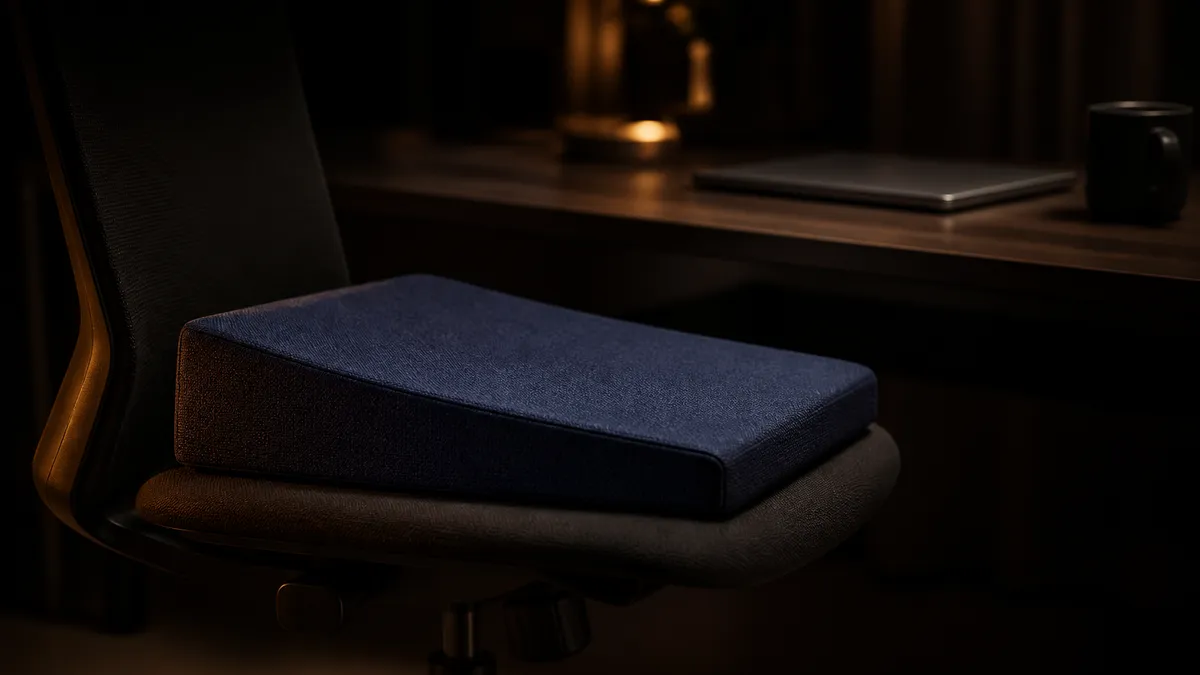
BackJoy has been selling the opposite premise since 1985, when, by the company’s own account, inventor Preston Willingham “invented the world’s first Back Orthotic seat to successfully heal his father’s back pain when all other non surgical solutions had failed.” The difference is not how much foam is involved — it is the form under the foam. BackJoy’s stated design action for the SitSmart Core 2.0 is that it “Tilts the pelvis upright to engage core muscles”: a cupped shape, higher at the back, that positions the pelvis rather than merely padding it.
The short answer: the SitSmart Core 2.0 is a posture device rather than a comfort cushion, and three conditions decide whether it works for you — the published 180-to-300 lb size band, a firm seat underneath it, and about three weeks of consistent use before you judge it. Miss any of the three and it will feel like an expensive shell. Meet them and it changes how a chair you already own treats your spine.
The size band that fits most US adults
BackJoy SitSmart Core 2.0 Posture Seat
SitSmart Core 2.0
BackJoy's best-selling shape for 180 to 300 lbs: a shaped orthotic base that, per the maker, tilts the pelvis upright rather than adding flat padding, with a wider seating surface and an anti-slip fabric cover.
- Best for
- Sitters from 180 to 300 lbs who want pelvic support on the firm chair they already own
- Sized for
- 180 to 300 lbs, per BackJoy
- Dimensions
- 40 x 40 x 10 cm (15.7 x 15.7 x 2.9 in)
- Surface
- Premium fabric covering with anti-slip grip areas
SitSmart Core 2.0 at a glance
| Specification | BackJoy SitSmart Core 2.0 |
|---|---|
| Sized for | 180 to 300 lbs, per BackJoy |
| Dimensions | 40 x 40 x 10 cm (15.7 x 15.7 x 2.9 in) |
| Construction | Orthotic base with 2x cushioning and a premium fabric cover |
| Surface | Anti-slip grip areas |
| Stated design action | ”Tilts the pelvis upright to engage core muscles” |
| Versus the original Core 1.0 | ”slightly more flex and tilt power,” per BackJoy |
| Colors | Wine, Black, Midnight (Teal) |
| Break-in guidance | ”At least 3 weeks of consistent use,” per BackJoy |
BackJoy describes the line as “ICA and ACA endorsed,” a reference to the International Chiropractors Association and the American Chiropractic Association, and says the products are “Recommended by medical doctors, nurses, Physical Therapists and Chiropractors.” Read those as manufacturer-cited endorsements rather than clinical evidence: they tell you the category is taken seriously by those bodies, not that any individual back will respond.
What the SitSmart Core 2.0 gets right
It changes the geometry instead of asking for discipline
Sitting up straight is not a discipline problem; it is a geometry problem. As soon as attention drifts, the pelvis rolls back, because on a flat seat that is the position that requires nothing from you. A seat that is raised at the back and cupped at the sides removes that default: the shape puts the pelvis closer to where a physical therapist would want it, and it keeps doing so while you read email, take a call, and forget entirely that you are sitting on anything.
The cushioning sits on top of that shape rather than replacing it. That is the distinction between an orthotic seat and a cushion — the angle comes from the form, and the foam only decides how the form feels.
It upgrades a chair you already own
A well-regarded ergonomic chair is a four-figure purchase and a delivery appointment. A seat orthotic is an object you set on the chair already under your desk — or the dining chair you actually work from, or the folding chair in the spare room. BackJoy’s own phrasing is that it “Works in any seat—office, car, home—or anywhere you sit!”, and the practical consequence is that one device follows you between the desk, the car, and a stadium bleacher.
For anyone who cannot justify replacing a chair, this is close to the cheapest structural change available to a home office.
The wider surface makes the action more forgiving
BackJoy’s product copy for the Core advertises “2x cushioning & wider seating surface,” and the company describes the difference in feel between its two main shapes bluntly: “The wider CORE is felt more at the hips due to its rounded shape,” where the narrower Relief shape’s action is “almost unnoticeable.” Width matters for heavier frames, which is exactly who the Core is sized for — a narrow orthotic under a broad pelvis concentrates pressure at the edges instead of cradling the sitting bones.
Against the original Core 1.0, BackJoy claims the 2.0 offers “slightly more flex and tilt power” — an incremental change rather than a new mechanism.
The sizing system is unusually honest
Most seat cushions are sold in one size with a vague promise. BackJoy publishes weight bands per shape and repeats them in the product titles: the Core as its “Best selling shape for 180 to 300 lbs,” the Relief Series as the best selling shape for 100 to 180 lbs, and the Relief MINI for lighter sitters still. That is a manufacturer telling a portion of its market not to buy the flagship — which is the most useful thing it can do, because the wrong band puts the pivot in the wrong place and the device quietly stops earning its space.
The limitations to accept
It needs a firm seat pan under it
An orthotic works by leverage, and leverage needs a base that stays put. Set the Core on a plush sofa, a soft gaming chair, or a heavily padded car seat and the whole assembly sinks together — you have added height, not angle. BackJoy notes that some owners report the narrower Relief performs better in car seats because it resists slipping, which is a polite way of saying that upholstered vehicle seats are the hardest environment for this design.
Before buying, press your palm into the middle of your chair’s seat pan. If your hand keeps going, plan on a rigid board underneath the orthotic, or expect a muted result.
The adjustment period is real, and it is measured in weeks
BackJoy asks for “at least 3 weeks of consistent use to feel significant and sustained pain relief,” and says temporary discomfort during the adjustment is normal. That is a fair disclosure and an inconvenient one. Muscles that have been idle while a chair back did the work will complain for the first several days, and anyone judging the purchase on day two will conclude it failed.
If you want a device that feels better immediately, this is the wrong category — plush cushions win that comparison and lose every later one.
It supports the pelvis, not the lower back
This is a seat, not a backrest. There is no lumbar pad, no strap, no shoulder component. The premise is that fixing the base changes what is stacked above it; for a back that specifically needs support behind the lumbar curve, an orthotic seat is at best half the answer and should be paired with a separate lumbar cushion.
The fabric cover is not the outdoor version
The Core 2.0’s fabric cover is made for a desk. If the seat is going to live in a truck, on a boat dock, or at a rained-on soccer field, BackJoy lists a waterproof EVA seat in the same size band — the SitSmart Posture Core 2.0 EVA, for 180 to 300 lbs — and that is the version to look at rather than the fabric Core. Lighter sitters have their own wet-weather options in the Relief band (the Posture Plus EVA and the Tech Gel Lightweight Sport, both listed for 100 to 180 lbs), but those are not substitutes if you are in the Core band.
Core, Relief, or MINI: pick by body weight
Everything else about this purchase is secondary to landing in the right band. BackJoy’s published figures:
| Shape | Published fit | Dimensions | Cover |
|---|---|---|---|
| SitSmart Core 2.0 | ”Best selling shape for 180 to 300 lbs” | 40 x 40 x 10 cm (15.7 x 15.7 x 2.9 in) | Premium fabric covering with anti-slip grip areas |
| SitSmart Relief Series | Best selling shape for 100 to 180 lbs | 38 x 32 x 10 cm (15 x 12.6 x 2.9 in) | Breathable fabric with a silicone traction layer |
| The Relief MINI | 60 to 120 lbs, “for flyweights under 100 lbs” | 37 x 27.5 x 10 cm (14.5 x 10.8 x 2.9 in) | Woven fabric with high-density foam |
The bands overlap at the edges in BackJoy’s own copy — the Relief page also says the shape fits adults up to 300 lbs and is best from 100 lbs upward — so treat the numbers as a first filter rather than a hard rule, and let the chair break the tie.
The Relief line is, in BackJoy’s description, intentionally narrower than hip or pelvis width, concentrating support under the sitting bones, and the company claims the MINI’s lifting and tilting action on the pelvis is as powerful as the Relief’s despite the smaller footprint. Going down a size is not a downgrade in effect; it is how the leverage stays aligned with a smaller frame.
| If you are… | Choose |
|---|---|
| 180 to 300 lbs, working at a desk | SitSmart Core 2.0 |
| 100 to 180 lbs, or often in a car seat | SitSmart Relief Series |
| Around 60 to 120 lbs, or petite just over 100 lbs | The Relief MINI |
| Outdoors or in wet conditions | The EVA version of your own band |
Between two bands — around 180 lbs — the deciding factor is the chair. A wide office seat hosts the Core comfortably; a compact dining or task chair suits the narrower Relief.
Who should buy it?
The Core 2.0 is a good fit if:
- You are in the 180-to-300 lb band and sit for long stretches on a firm office or dining chair.
- Your lower back complains by mid-afternoon and adding padding has not helped.
- You want the change to work without you having to remember it.
- You need one device to move between a desk, a car, and a folding chair.
Skip it if:
- Your chair or sofa is deeply padded and you will not put a board under it.
- You weigh under about 180 lbs — the Relief or MINI is the correct product, not a smaller compromise.
- You need lumbar support behind you rather than pelvic support beneath you.
- You want relief today and will not give it three weeks.
Frequently asked questions
Does it work in a car?
BackJoy says its seats work in any seat, including cars, but also notes owner feedback that the narrower Relief performs better in vehicles because it resists slipping. Upholstered car seats compress, so expect a weaker effect there than on a firm office chair, whichever shape you choose.
How long until I know whether it worked?
The company asks for at least three weeks of consistent use, and describes some discomfort during the adjustment as normal. Judge it at the end of that window, not on the first afternoon.
Is it a replacement for an ergonomic chair?
No — it replaces one function of one. A good chair also handles seat height, backrest angle, and arm support. The orthotic addresses only pelvic angle, which happens to be the variable most commonly wrong in a cheap chair.
Will it fit a narrow chair?
The Core measures 40 x 40 cm (15.7 x 15.7 in), which overhangs some compact task chairs and most dining chairs. Measure the seat pan first; if it is tight, the Relief at 38 x 32 cm (15 x 12.6 in) is the shape that fits.
Can I wash it?
The fabric-covered Core is not marketed as a washable product. If washability or waterproofing is a requirement, BackJoy’s EVA seats are the versions built for it — the Posture Core 2.0 EVA in this weight band, or the Posture Plus EVA in the lighter Relief band.
What about very light adults?
The Relief MINI covers 60 to 120 lbs, and BackJoy describes it as being for “flyweights under 100 lbs” and for petite individuals just over 100 lbs. The pelvic action is claimed to be as strong as the full-size Relief.
Final verdict
The SitSmart Core 2.0 is worth buying if you treat it as equipment rather than as a cushion. Its logic is consistent all the way through: a shaped base that sets the pelvis at an angle you would not hold voluntarily, cushioning layered on top of that shape rather than in place of it, and a published weight band that tells you whether you are the intended user. Nothing about it is plush, and that is the point.
The honest caveats are the ones that decide the outcome. It needs a firm seat under it, it asks for three weeks before delivering a verdict, and it stops well short of being a whole ergonomic chair. Those are also the three things to settle before ordering: press your palm into the seat pan you actually use, check your weight against the published band, and be willing to give the adjustment period its time. Skip those steps and no orthotic seat — this one included — will read as anything but a hard plate.
If you are in the 180-to-300 lb band, the Core is the shape to start with. If you are not, the more valuable takeaway from this review is which one to buy instead.
Check your weight band and seat firmness first
BackJoy SitSmart Core 2.0 Posture Seat
SitSmart Core 2.0
BackJoy's best-selling shape for 180 to 300 lbs: a shaped orthotic base that, per the maker, tilts the pelvis upright rather than adding flat padding, with a wider seating surface and an anti-slip fabric cover.
- Best for
- Sitters from 180 to 300 lbs who want pelvic support on the firm chair they already own
- Sized for
- 180 to 300 lbs, per BackJoy
- Dimensions
- 40 x 40 x 10 cm (15.7 x 15.7 x 2.9 in)
- Surface
- Premium fabric covering with anti-slip grip areas
Sources and methodology
This is a research-based buying guide, not a hands-on test. We have not tested the BackJoy SitSmart Core 2.0 ourselves. Specifications, weight bands, dimensions, and usage guidance were checked against BackJoy’s published US product pages on August 20, 2026, and quoted wording is the manufacturer’s own. Retail availability, listings, and pricing change independently of these specifications, and endorsements cited by the manufacturer are not clinical evidence.