Desk Setup
Best Japanese Mechanical Pencils in 2026: Kuru Toga vs Orenz Nero vs GraphGear 1000
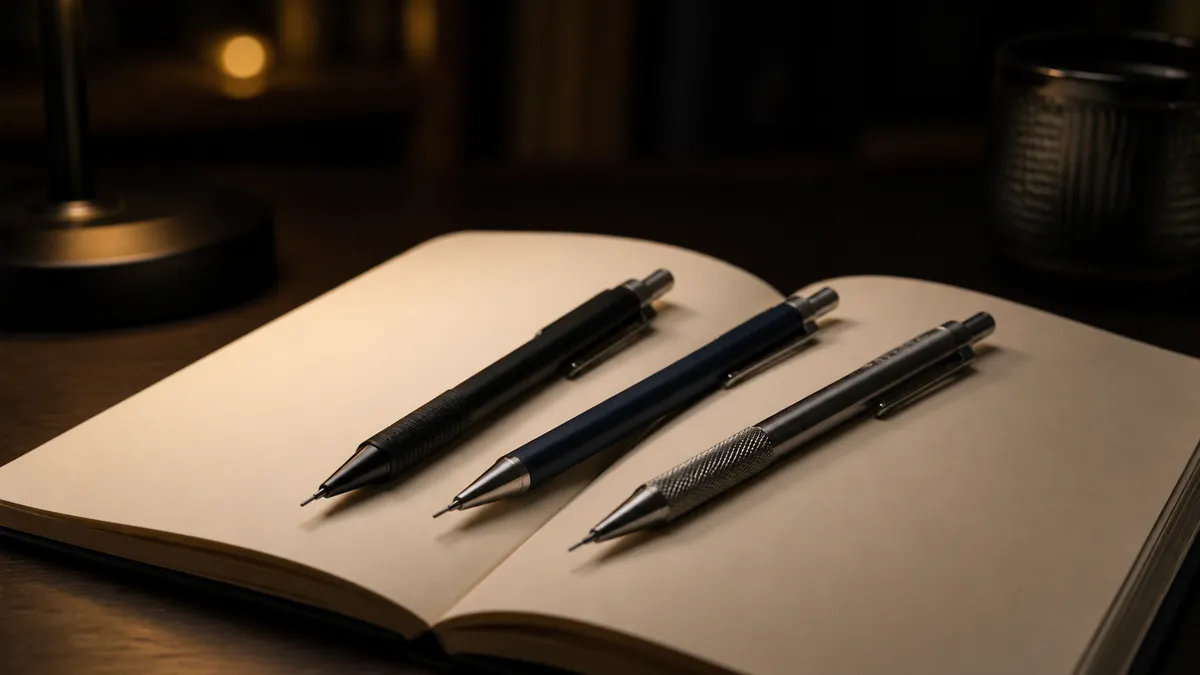
A research-based comparison of Japan's three defining mechanical pencils — Uni's rotating Kuru Toga Advance, Pentel's auto-advancing Orenz Nero, and the metal GraphGear 1000 drafting classic.
Research note: This guide compares published specifications and current retail information. It is not presented as a hands-on test.
Disclosure: As an Amazon Associate I earn from qualifying purchases. Product links marked “paid link” may earn AmeChoi a commission.
Contents
- The quick answer
- Why Japanese pencils are a category of their own
- Best for everyday writing: Uni Kuru Toga Advance
- Best premium fine-liner: Pentel Orenz Nero
- Best metal workhorse: Pentel GraphGear 1000
- Head-to-head
- Buying checks before ordering
- Match the model, not the family name
- Pick lead size by handwriting, not spec sheet
- Bundles vs single pens
- Frequently asked questions
- Does the Kuru Toga rotation actually matter?
- Is the Orenz Nero worth several times the price of the others?
- Which is best for engineers and technical drawing?
- Do they use special leads?
- Are these good gifts?
- Final verdict
- Sources and methodology
A mechanical pencil seems like a solved problem until you look at what Japanese makers keep doing to it. While most of the world treats the category as disposable office supply, Uni and Pentel have spent the past two decades engineering away the three small annoyances every pencil user knows: the lead that wears into a flat chisel edge, the click-click-click ritual every few lines, and the snapped tip that ruins a stroke.
Each of the three pencils in this guide solves one of those problems so distinctly that “which is best” is really “which annoyance do you want gone.”
The short answer: the Uni Kuru Toga Advance is the best everyday pick for people who write a lot, the Pentel Orenz Nero is the premium choice for fine-line perfectionists, and the Pentel GraphGear 1000 is the metal workhorse for drafting-style use. All three cost less than a mediocre dinner, which makes this one of the cheapest ways to buy a genuinely engineered Japanese tool.
The quick answer
| Pick | Best for | The trick | Lead |
|---|---|---|---|
| Kuru Toga Advance | Daily writing, students, notes | Rotates the lead to keep the point conical | 0.5 mm |
| Orenz Nero | Fine lines, zero interruptions | Advances lead automatically — no clicking | 0.5 mm (also 0.2/0.3) |
| GraphGear 1000 | Drafting, EDC, metal-body fans | Fully retracting tip in a metal barrel | 0.5 mm (also 0.3–0.9) |
Why Japanese pencils are a category of their own
The engineering claims here are not marketing garnish; each mechanism is the product’s entire identity, documented by its maker.
Uni’s Kuru Toga engine uses writing pressure itself to ratchet the lead around in tiny increments each time the tip leaves the paper. Over a line of text the lead rotates enough that it wears evenly into a cone instead of a flat edge — so the line stays thin and the tip resists snapping. The Advance model uses uni’s faster-rotating version of the engine, so the effect appears even in short strokes.
Pentel’s Orenz system attacks breakage differently: a sliding guard pipe stays over the lead and retreats as the lead wears, so the fragile graphite is always supported. The Nero adds Pentel’s automatic advance — lift the pencil off the page and a fresh sliver of lead feeds out, no clicking, until the stick is spent.
The GraphGear 1000 is the oldest idea of the three, refined rather than reinvented: a proper drafting pencil with a 4 mm fixed sleeve for ruler work, in a knurled metal barrel, whose party trick is a dual-action retractor that pulls the entire tip assembly inside the body — the reason it survives pockets and pencil cases that kill other drafting pencils.
Best for everyday writing: Uni Kuru Toga Advance
Best everyday pick
Uni Kuru Toga Advance
M5-559 · 0.5 mm
The pencil that made Japanese stationery famous again: a tiny internal engine rotates the lead each time it leaves the paper, so the point stays conical and the line stays thin instead of wearing flat.
- Best for
- Students and note-takers who write pages every day
- Mechanism
- Kuru Toga rotation engine (W-Speed) spins the lead as you write
- What it fixes
- Flat chisel points, fat lines, snapped tips
- Lead
- 0.5 mm (family includes 0.3 and 0.7)
- Body
- Lightweight resin, everyday grip
The Kuru Toga is the pencil to recommend to almost anyone who writes by hand daily. The rotation engine works invisibly — you simply notice, after a page, that your line width never grew and you never rotated the pencil in your fingers the way every pencil user unconsciously does.
The Advance version is the sweet spot of the family. Its faster rotation makes the mechanism effective even for short notes, and the sliding tip pipe adds a measure of break resistance. The body is light resin: comfortable for long sessions, unremarkable to look at, and cheap enough to lose without grief.
Reasons to skip it: the mechanism needs writing pressure lifting on and off the page, so it does the least for people who write in long, continuous strokes or hold very light pressure. And if you want a pencil that feels like a premium object, the resin body will not scratch that itch — that is the Nero’s job.
Best premium fine-liner: Pentel Orenz Nero
The premium pick
Pentel Orenz Nero
PP3005-A · 0.5 mm
Pentel's flagship: an automatic advance feeds lead as you write and a sliding guard pipe shields the tip, making even ultra-fine leads practical. The matte black metal body is the premium object of this trio.
- Best for
- Fine-line writers who never want to click again
- Mechanism
- Automatic lead advance — write until the lead runs out
- Anti-break
- Orenz sliding guard pipe supports the lead tip
- Lead
- 0.5 mm (family includes ultra-fine 0.2 and 0.3)
- Body
- Low-center metal composite barrel, made in Japan
The Orenz Nero is the pencil that stationery enthusiasts hand people to explain why Japanese pencils are different. Write a word, and the lead simply keeps coming — the automatic advance feeds it as you lift between strokes. Combined with the Orenz guard pipe, it makes ultra-fine 0.2 and 0.3 mm leads genuinely usable, sizes that would snap constantly in a conventional pencil.
The matte-black barrel is a low-slung metal-composite design, noticeably denser than a plastic pencil, and it is made in Japan. The 0.5 mm version reviewed here is the practical entry; the 0.2 and 0.3 mm variants are the specialist’s tools for tiny marginalia, dense math, and technical sketching.
Reasons to skip it: it costs several times what the other two do, and the automatic advance has a learning curve — the guard pipe touching paper feels unfamiliar for the first pages. Heavy-pressure writers who bear down hard get less benefit from ultra-fine leads in general.
Best metal workhorse: Pentel GraphGear 1000
The drafting classic
Pentel GraphGear 1000
PG1015A · 0.5 mm
The long-running drafting classic: a weighty metal body, a knurled grip, and a retractable 4 mm sleeve that makes it the rare precision pencil you can safely drop into a pocket.
- Best for
- Drafting-style users who want a metal workhorse
- Build
- Metal barrel, knurled grip with soft pads
- Pocket-safe
- Dual-action retractor pulls the whole tip in
- Drafting
- 4 mm fixed sleeve for rulers and templates
- Lead
- 0.5 mm (family includes 0.3, 0.7, 0.9), grade indicator
The GraphGear 1000 has been a fixture of drafting tables, engineering programs, and everyday-carry forums for years, and the reasons are all physical. The barrel is metal with a knurled grip inset with soft pads. The 4 mm fixed sleeve rides cleanly along rulers and templates. A lead-grade indicator on the barrel tells you whether HB or 2B is loaded. And the dual-action retractor — click the clip and the whole tip snaps inside — makes it the rare drafting pencil that is safe in a jeans pocket.
It has no rotation engine and no auto-advance. What it offers instead is heft, balance, and the sense of a precision instrument that the other two, for all their cleverness, deliver less of.
Reasons to skip it: the metal body is front-heavier than either rival, which some writers love and some tire of over long sessions. If your writing is pages of prose rather than lines and figures, the Kuru Toga’s invisible assistance is the more useful kind of engineering.
Head-to-head
| Feature | Kuru Toga Advance | Orenz Nero | GraphGear 1000 |
|---|---|---|---|
| Signature mechanism | Lead rotation engine | Auto lead advance + guard pipe | Retractable drafting tip |
| Solves | Flat points, fat lines | Clicking, tip breakage | Pocket damage, ruler work |
| Body | Light resin | Metal composite, matte black | Metal, knurled grip |
| Lead sizes in family | 0.3 / 0.5 / 0.7 | 0.2 / 0.3 / 0.5 | 0.3 / 0.5 / 0.7 / 0.9 |
| Price tier | Everyday | Premium | Mid |
| Personality | Invisible helper | Engineering flex | Reliable instrument |
All three take standard leads of their size and standard-fitting erasers, and refills from uni and Pentel are widely stocked on Amazon in the US — running costs are trivial for all three.
Buying checks before ordering
Match the model, not the family name
Both makers sell many variants under the same names. This guide covers the Kuru Toga Advance (M5-559, 0.5 mm), the Orenz Nero (PP3005-A, 0.5 mm), and the GraphGear 1000 (PG1015A, 0.5 mm). Listings often mix standard Kuru Toga, Advance, and the premium Dive in one page — the model code is the reliable check.
Pick lead size by handwriting, not spec sheet
0.5 mm is the safe default for English handwriting. Go 0.7 if you press hard or write large; consider the Nero’s 0.3 only if you genuinely write small. Ultra-fine leads reward light-handed writers and punish heavy pressure regardless of the pencil’s cleverness.
Bundles vs single pens
US listings frequently bundle these pencils with lead and erasers at a slightly higher price. The bundles are fine value if you need refills anyway; just confirm the pencil model inside the bundle matches the one you chose.
Frequently asked questions
Does the Kuru Toga rotation actually matter?
For multi-page handwriting, yes — the even wear is visible if you compare a page written with the mechanism against a conventional pencil. For occasional jotting, the difference shrinks. It is engineering for people who write volume.
Is the Orenz Nero worth several times the price of the others?
As a tool, its two mechanisms are real and unduplicated. As a purchase, it is also partly an object of craft — a made-in-Japan metal pencil with a distinctive matte finish. If that framing appeals, it earns its price; if a pencil is purely consumable to you, buy the Kuru Toga and never look back.
Which is best for engineers and technical drawing?
The GraphGear 1000 — the 4 mm sleeve, lead-grade indicator, and metal build are drafting features the other two lack. The Nero’s 0.3 mm variant is the alternative when line fineness matters more than ruler work.
Do they use special leads?
No. All three take standard leads in their marked size. Stronger aftermarket leads (like uni’s NanoDia or Pentel’s Ain) are widely available in the US and worth pairing with fine sizes.
Are these good gifts?
The Nero is one of the best small gifts in Japanese stationery — premium feel, obvious mechanism, modest cost. The other two are better bought as personal workhorses.
Final verdict
Buy the Kuru Toga Advance if you write every day — it is the most benefit for the least money and the least thought. Buy the Orenz Nero if fine lines and uninterrupted writing sound like luxury worth paying for — nothing else in the category does what it does. Buy the GraphGear 1000 if you want a precision metal instrument that shrugs off pockets and rules straight lines.
For the desk these pencils sit on, our HHKB keyboard comparison and ELECOM trackball guide cover the rest of the Japanese-tools ecosystem.
Everyday writing
Uni Kuru Toga Advance
M5-559 · 0.5 mm
The pencil that made Japanese stationery famous again: a tiny internal engine rotates the lead each time it leaves the paper, so the point stays conical and the line stays thin instead of wearing flat.
- Best for
- Students and note-takers who write pages every day
- Mechanism
- Kuru Toga rotation engine (W-Speed) spins the lead as you write
- What it fixes
- Flat chisel points, fat lines, snapped tips
- Lead
- 0.5 mm (family includes 0.3 and 0.7)
- Body
- Lightweight resin, everyday grip
Fine lines, zero clicks
Pentel Orenz Nero
PP3005-A · 0.5 mm
Pentel's flagship: an automatic advance feeds lead as you write and a sliding guard pipe shields the tip, making even ultra-fine leads practical. The matte black metal body is the premium object of this trio.
- Best for
- Fine-line writers who never want to click again
- Mechanism
- Automatic lead advance — write until the lead runs out
- Anti-break
- Orenz sliding guard pipe supports the lead tip
- Lead
- 0.5 mm (family includes ultra-fine 0.2 and 0.3)
- Body
- Low-center metal composite barrel, made in Japan
Metal drafting workhorse
Pentel GraphGear 1000
PG1015A · 0.5 mm
The long-running drafting classic: a weighty metal body, a knurled grip, and a retractable 4 mm sleeve that makes it the rare precision pencil you can safely drop into a pocket.
- Best for
- Drafting-style users who want a metal workhorse
- Build
- Metal barrel, knurled grip with soft pads
- Pocket-safe
- Dual-action retractor pulls the whole tip in
- Drafting
- 4 mm fixed sleeve for rulers and templates
- Lead
- 0.5 mm (family includes 0.3, 0.7, 0.9), grade indicator
Sources and methodology
This is a research-based buying guide, not a hands-on test. Mechanisms and model details were checked against the manufacturers’ published product pages on August 15, 2026. Retail availability and pricing change independently of these specifications.